Use the Edge SDK on an AWS EC2 instance
An application on an AWS EC2 instance authenticates to Aembit through the AWS Metadata Service Trust Provider: Trust Providers validate Client Workload identities through workload attestation, verifying identity claims from the workload's runtime environment rather than relying on pre-shared secrets.Learn more for that instance. That Trust Provider verifies the signed instance identity document that the AWS Instance Metadata Service (IMDS) provides. The Edge SDK reads that document and runs the authentication exchange. You configure the SDK client and request a credential.
How an EC2 instance proves its identity
Section titled “How an EC2 instance proves its identity”An EC2 instance reads a signed instance identity document from IMDS over a link-local HTTP request. The document describes the instance, including its account, region, and instance ID. AWS signs the document, so the signature proves it came from AWS rather than from the workload.
The Edge SDK reads both the document and its signature over IMDSv2 and sends them to Aembit. Aembit validates the signature. It then evaluates the document’s fields against the Match Rule: Match Rules are the conditions a Trust Provider evaluates against a workload's attested identity claims, determining which workloads that Trust Provider accepts.Learn more on your AWS Metadata Service Trust Provider. Because the signed document is the evidence, no credential or token has to exist on the instance ahead of time.
For the request and response shapes behind that exchange, see Edge API authentication with AWS Metadata Service.
Before you start
Section titled “Before you start”- An Aembit Tenant: Aembit Tenants serve as isolated, dedicated environments within Aembit that provide complete separation of administrative domains and security configurations.Learn more with at least Read Only permission for Trust Providers.
- An Access Policy: Access Policies define, enforce, and audit access between Client and Server Workloads by cryptographically verifying workload identity and contextual factors rather than relying on static secrets.Learn more for the service your application reaches.
- An AWS Metadata Service Trust Provider with match rules that identify your EC2 instance.
- An EC2 instance with IMDSv2 enabled and reachable at
169.254.169.254, running Node.js 20 or later.
Get your Edge SDK Client ID
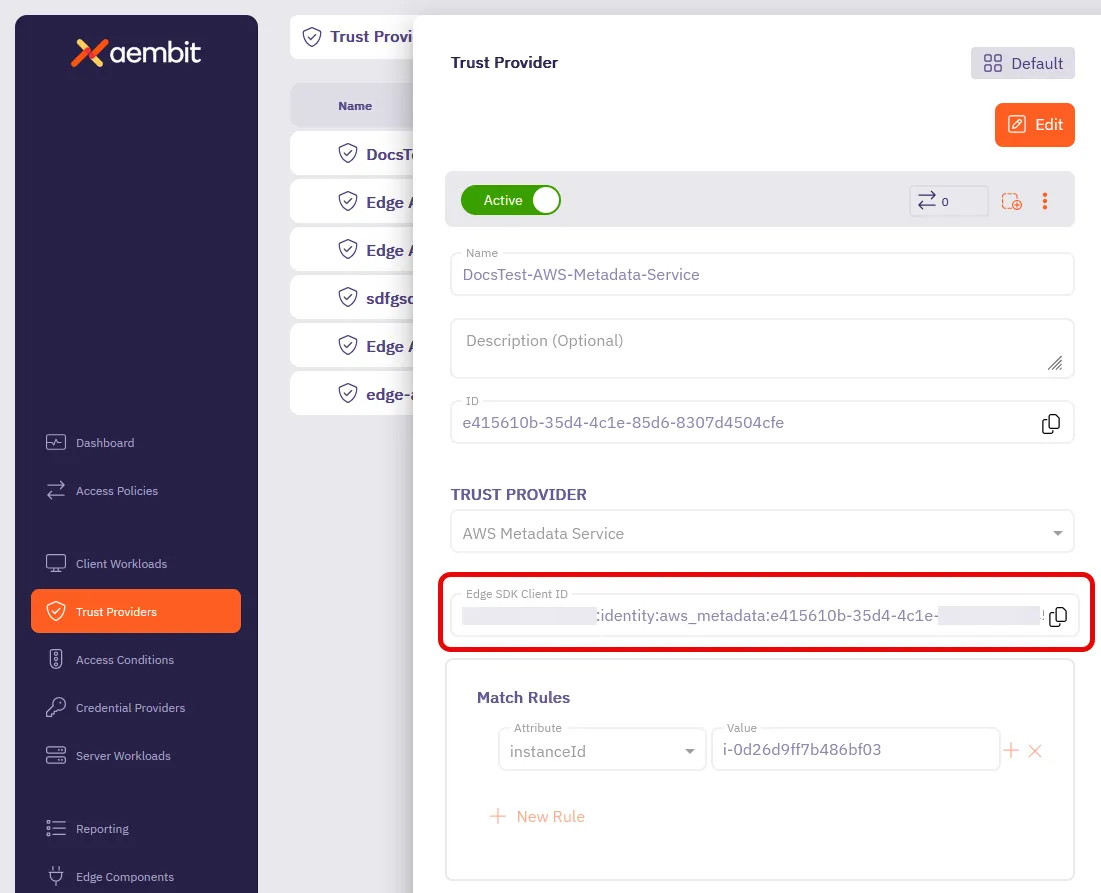
Section titled “Get your Edge SDK Client ID”Your application needs the Edge SDK Client ID: A structured identifier that Aembit generates when you configure a Trust Provider, encoding your region, tenant, and Trust Provider. It identifies a Trust Provider rather than an individual Client Workload.Learn more from the AWS Metadata Service Trust Provider whose match rules identify your EC2 instance.
-
Log in to your Aembit Tenant.
-
Go to the Trust Providers section in the left sidebar.
-
Select the Trust Provider you want to use for Edge API authentication.
-
In the TRUST PROVIDER section, find the Edge SDK Client ID field.
-
Copy the Edge SDK Client ID to use in your authentication requests.
Wire up the SDK
Section titled “Wire up the SDK”The example collects every value you change into one EXAMPLE_CONFIG object at the top of the file.
The AWS Metadata Service Trust Provider takes no configuration of its own, because the SDK reads what it needs from
IMDS at runtime.
const EXAMPLE_CONFIG = { baseUrl: "https://<tenant>.ec.<stack>.aembit.io", clientId: "your-edge-sdk-client-id", serverHost: "target.example.com", serverPort: 443, credentialType: "ApiKey", resourceSet: undefined as string | undefined}Where each value comes from in Aembit:
| Value | Where it comes from |
|---|---|
baseUrl | The Edge API Base URL field in your Aembit Tenant profile. See Get your Aembit Edge API base URL. |
clientId | The Edge SDK Client ID you copied from the Trust Provider. |
serverHost and serverPort | The Service Endpoint on your Server Workload: Server Workloads represent target services, APIs, databases, or applications that receive and respond to access requests from Client Workloads.Learn more, matched exactly, because Aembit resolves the Access Policy from these values. |
credentialType | The credential type your Credential Provider: Credential Providers obtain the specific access credentials—such as API keys, OAuth tokens, or temporary cloud credentials—that Client Workloads need to authenticate to Server Workloads.Learn more returns. |
resourceSet | Leave undefined unless your Access Policy lives in a non-default Resource Set. |
Run the example
Section titled “Run the example”The Edge SDK repository carries a runnable version of this integration, including how to bundle it and copy it to an instance.
Troubleshooting
Section titled “Troubleshooting”Every error the Edge SDK raises carries a kind, which narrows the failure to one side of the exchange.
auth: Aembit received the instance identity document and rejected it. ConfirmclientIdholds the Edge SDK Client ID from the AWS Metadata Service Trust Provider. Confirm the Trust Provider’s match rules identify this instance’s account, region, and instance ID.credential: Aembit authenticated the instance but returned no credential for the service you requested. Confirm that the Service Endpoint on your Server Workload exactly matchesserverHostandserverPort, because Aembit resolves the Access Policy from those values. Confirm the Access Policy includes the Client Workload for this instance. Confirm the Credential Provider on that policy returns thecredentialTypeyour application requested.
Alongside kind, each error carries statusCode, apiCode, and requestId when Aembit supplies them, and retryable
to report whether another attempt might succeed.
Include requestId when you contact Aembit Support.